

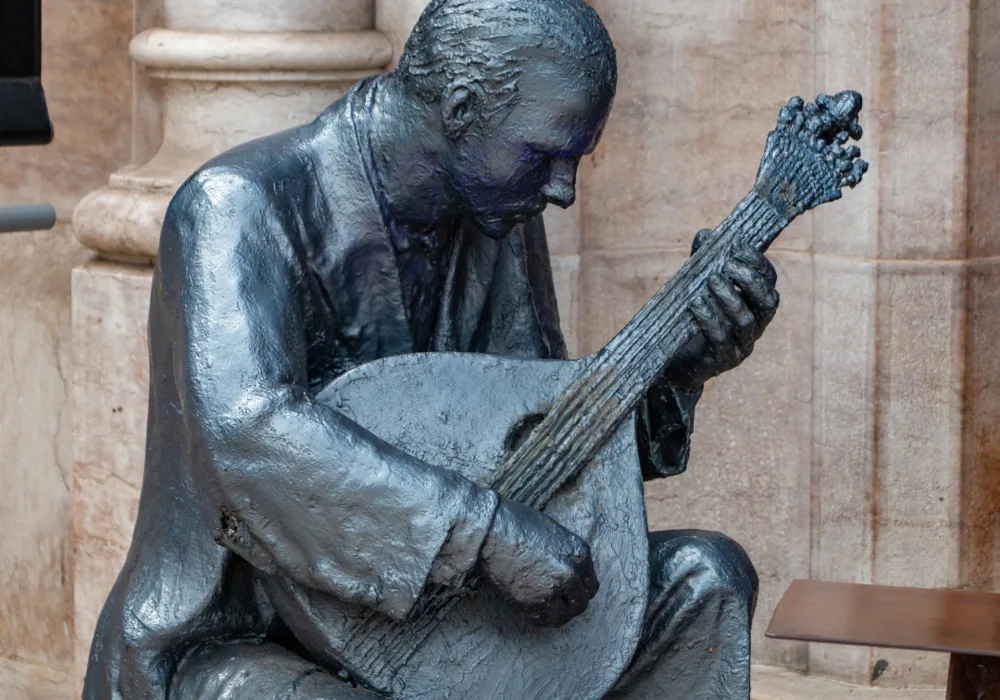
Fado’s melodies are fixed and its poems pass from one voice to the next, so it is the singer who makes the difference.
Augusto Hilário
Hilário arrived in Coimbra in 1889 or 1890 to study medicine, and found Fado there. He sang poems by writers of his day and became known across the country, and although he died young, the quatrains he wrote outlived him.
Alfredo Marceneiro
Marceneiro began singing around 1905, at thirteen, and became known for improvising. He sang at parties and in cegadas, satirical street plays, until 1924, when he performed at the Teatro São Luiz and won a silver medal. He retired in 1963 at the same theatre, and kept singing. From those years comes The Fabulous Marceneiro, which the music paper Blitz rated among the finest Portuguese records ever made.
Amália Rodrigues
Between 1943 and 1990 Amália sang on five continents. In 1953 she became the first Portuguese artist on American television, on NBC’s Coke Time with Eddie Fisher. She also worked in revue theatre and film. Her Povo que Lavas no Rio is still sung in the Fado houses. She has lain in the National Pantheon since 2001.
Carlos do Carmo
The son of the singer Lucília do Carmo, Carlos do Carmo made his debut in 1963 with Júlio de Sousa’s Loucura. In 1970 he gave concerts in Angola, the United States and Canada, and in 1976 he represented Portugal at the Eurovision Song Contest with Uma Flor de Verde Pinho, on a poem by Manuel Alegre. He died in 2021.
Camané
Camané started as an amateur and won the Grande Noite do Fado at twelve, a contest whose past entrants include Marina Mota, Anabela Pires, Raquel Tavares and Ricardo Ribeiro. His third album went silver in 2000, the fourth went silver three weeks after its release, and the fifth went gold.
Mariza
Fado em Mim, released in 2001, reached thirty-two countries, and on it is Mariza’s version of Ó Gente da Minha Terra, a poem by Amália. The album that followed, Fado Curvo, reached sixth place on Billboard’s World Music chart.