

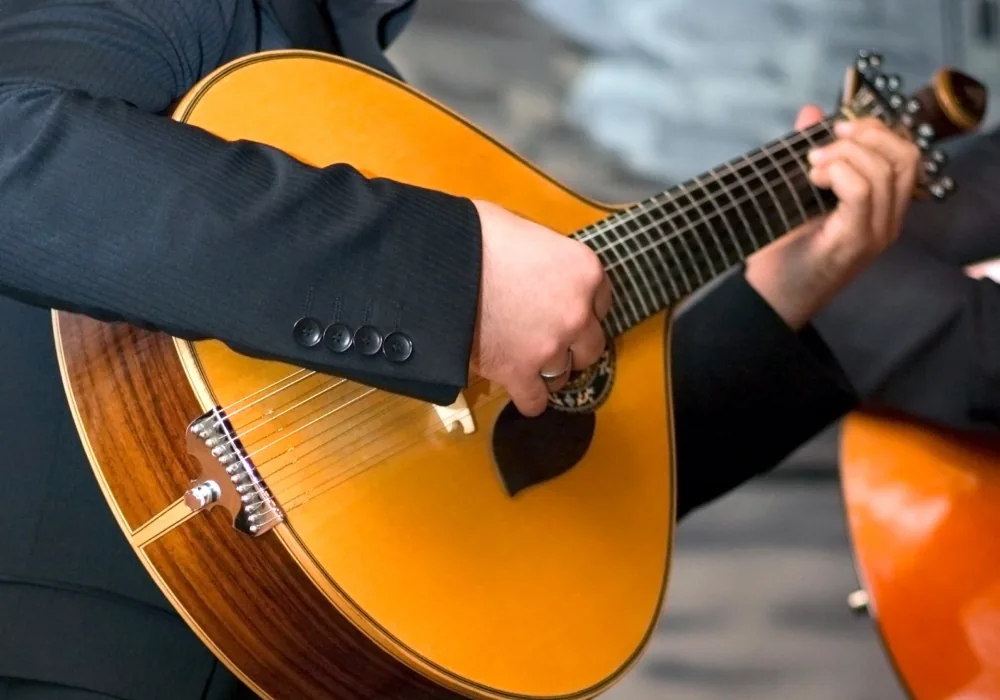
The Portuguese guitar has twelve metal strings in six pairs. It descends from the English guitar and appeared at the end of the eighteenth century, but little else is known of its origins, because the documents are missing.
Lisbon, Coimbra and Porto guitars
The three models differ mainly in how they are built. The Lisbon guitar is the smallest, with a rounded body and a scroll at the head. The Coimbra guitar is larger and sharper in outline, with a teardrop-shaped head. The Porto guitar is built much like the Lisbon one and is the oldest of the three.
Armandinho and the players around him
Armando Augusto Freire, known as Armandinho, was born in 1891. He began studying the Portuguese guitar at fourteen and played the Teatro das Trinas the same year. His compositions became required repertoire for the instrument.
Martinho d’Assunção, born in Lisbon in 1914, studied classical guitar, mandolin and violin before turning to the Portuguese guitar in 1927, and played in Portugal and abroad with Armandinho, Ercília Costa and João de Mata. João de Mata was a poet as well as a guitarist. He toured Africa with the Grupo Artístico de Fado, ran the Jornal Canção Nacional in 1927 and 1928, and edited Guitarra de Portugal until his death.
The guitarists who played with Amália
Jaime Santos, born in 1909, came to the instrument the way Martinho d’Assunção did: by twelve he already played classical guitar, violin and mandolin, and the Portuguese guitar came later. Over his life he accompanied Georgino de Sousa, Armandinho, Martinho d’Assunção and Amália Rodrigues.
Raul Nery first played at nine and went on to accompany Amália on tours in Portugal and abroad. He also worked as an engineering technician and stopped performing early, but he is on hundreds of recordings.